
Charlotte Burton |
Choosing a Wedding Dress That Perfectly Complements Your Engagement Ring
A bride who walks down the aisle wearing a Toi et Moi ring — (French for “you and me,” with two stones sitting side‑by‑side on a single band) — and a heavily beaded ball gown is essentially signing up for a day‑long custody battle over attention. One sparkly contender on the hand, one sparkly contender on the body, and — let’s be honest — the dress usually wins without even breaking a sweat. By the time the wedding arrives, half the guests have already inspected the ring !
But beneath all the shimmer and spectacle, people get married to honour love and commitment — and that’s exactly what the wedding band has symbolised for centuries. In this article, we explore how the dress and the ring should exist in the same visual universe, not competing like rival performers but working together like a beautifully coordinated duo. The dress takes the lead, the ring supports and together they create a look that quietly announces , “I planned this.”
Neckline and Ring Visibility
A favourite neckline isn’t just a style preference – it’s a visual strategy. The neckline you choose quietly dictates where the eye travels first, and that path determines how your jewellery – especially your ring – shows up in photos and in person
A V-neck or plunging neckline naturally draws the gaze towards the center of the chest, and the eye travels down the V to the hand resting at the side. Solitaire rings and small-stones thrive here because they fall directly into a sightline that already has momentum. A Sweetheart neckline creates similar effect , just with a softer more romantic curve.
High necks and bateau cuts work in the opposite direction. They keep the focus high -the collar, chin and the face. Rings with strong center stones, architectural settings or wider bands hold their own beautifully because the hand becomes its own focal zone, not competing with exposed skin or statement jewellery at the neck.
Halter and one-shoulder silhouettes redirect attention to the shoulder line. Bracelet stacks work well with this dress shape alongside bold, heavy three-stone or chunky bezel rings .
Silhouette and Ring Scale
Ball gowns and the ever – popular Aline dress both carry visual weight through the skirt which means the lower half of the dress dominates the frame in photos. With all that volume and movement , a very delicate small ring can appear almost lost against the sweep of fabric . Larger centre stones, halo settings and three s-stone designs hold their own beautifully in these silhouettes because they offer enough presence to balance the grandeur of the skirt . The proportions feel intentional , a statement gown paired with a ring that can stand confidently beside it .
Sheath, slip, and crepe column dresses move in the opposite direction. The fabric falls clean, and the eye stays on the body line. Smaller, lower-profile rings work in this register. A 1.5-carat solitaire on a slim band reads cleanly against a satin slip dress.
Fishtail and Fit- to- Flare dresses sit between these two elements. The fitted bodice and flared bottom create two distinct fields, and rings of medium scale tend to work best, since they can hold attention without competing with the dress’s strong sculptural shape.
Distinctive Ring Choices and the Dress
Subconsciously the engagement ring often sets the visual tone for the dress and in many ways for the entire aesthetic of the wedding day. Salt-and-pepper diamonds, antique cluster heads, hand-engraved bands, and bold signet flat tops each carry their own distinct design language. The dress feels more harmonious when it echoes that language somewhere in its construction – whether through texture, silhouette , embellishment or overall mood.
Brides who select a unique engagement ring often arrive at their dress fitting already attuned to the visual register the ring establishes. From there, the dress selection tends to unfold naturally. A vintage- inspired ring might pair effortlessly with a dress featuring lacework, heirloom -style beading or Edwardian lines, while a clean, modern silhouette aligns beautifully with a single solitaire on a minimalist band.

Metal Tone and Dress Color
White gold and platinum read coolest against pure white and ivory. The cool-on-cool pairing keeps the look consistent. Yellow gold and rose gold sit warmer, and they pair more naturally with champagne, blush, and slightly off-white gowns, where the dress already carries warm undertones.
The mismatch case is loud. A platinum solitaire against a champagne gown will read as a cool point against a warm field, and the eye picks up the tonal gap before it picks up either piece on its own. Some brides use this deliberately for contrast, but the choice should be intentional rather than the result of two separate decisions made in isolation.
Two-tone bands and mixed-metal rings give the most flexibility. They work against either dress tone since the band itself includes both registers.
Detail Density and Ring Profile
A heavily beaded dress with crystal embroidery, lace appliqué, and pearl detailing already carries a high level of visual information. Rings with intricate filigree, milgrain edges, and small accent stones can easily disappear against such ornate surfaces. .The cleaner solution is to either increase the rings scale or reduce the dress embellishments so the two elements can breathe.
The reverse pairing is always more successful. A clean satin slip dress or a crepe sheath provides a quiet, uninterrupted field for the ring to sit against allowing intricate designs to read clearly without competing with embroidery or beading. Many of the antique cluster and rose-cut pieces currently in demand thrive in this context because the gown plays a supporting role rather than the leading one.
Sleeve and Bracelet Considerations
Even long sleeves can influence how clearly the engagement ring reads. Llace sleeves with a floral motif tend to frame the hand beautifully , creating negative space that draws the eye to the ring. In contrast, solid satin or crepe sleeves can visually ‘swallow; the hand, especially if the ring is delicate . Brides who want full sleeves but still want an unobstructed view of the ring during the ceremony often choose Detached gloves as a practical compromise.
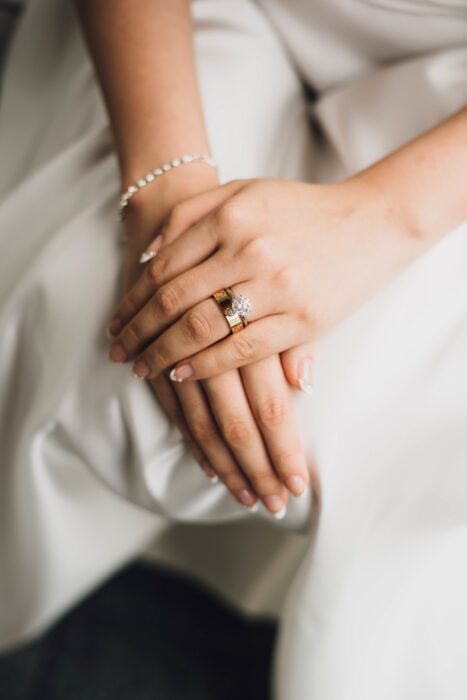
Bracelets and ring stacks should be considered as a single composition rather than separate decisions. A tennis bracelet worn on the ring hand places two pieces of jewellery within just a few inches of each other, and the bracelet can either enhance or overpower the ring depending on scale and sparkle. Most brides prefer to let one piece take visual priority while keeping the other understated. These choices are best made during the final fitting, when the full outfit and proportions can be evaluated together.
Practical Fitting Issues
The ring should be worn to every fitting from the second appointment onward. The seamstress will adjust waistlines, hemlines, and sleeve cuts based on how the body moves with the ring on. A bride who removes the ring for fittings and only puts it on for the wedding day can end up with sleeves that catch, gloves that pull, or bracelet stacks that interfere with the bouquet hand.
Photography also matters at the fitting stage. Wedding ring photography follows specific framing during the day, and the dress angles that produce the best ring-and-hand frame are different from the angles that flatter the dress alone. A test photo session with the ring on can confirm that both pieces read clearly in the same shot.
Final Notes for the Pairing
The dress and the ring belong to the same visual decision, even when they are bought in separate places at separate times. The ring tends to be permanent, so the dress is the variable that needs to adapt. Brides selecting the dress after the ring already exists have the easier path, since the dress can be picked to support whatever has already been committed.
For brides selecting both at the same time, the cleaner sequence is to pick the ring first, keep a reference photo of it for every dress fitting, and treat the dress as the supporting piece rather than the lead.
The day photographs better, the pieces hold together visually, and the year of post-wedding scroll-back rewards the consistency rather than punishing two strong choices made in parallel.
And thats it did you ever consider all these factors when choosing your wedding dress ? We hope your love this guide.